

ERP essentials4 min read
Seven signs your business has outgrown spreadsheets
Typing data twice, stock nobody trusts, a week-long month-end: seven signs it is time for one system.
DeadlinesE-Invoicing by Dec 31, 20262026 Computerized Books in ORUS by Jan 30, 2027E-Invoicing Dec 31 · ORUS Jan 30
Check ReadinessSingapore is making InvoiceNow mandatory for every GST-registered business, in phases that run to April 2031. Here is when your business is due, who is exempt, and how to prepare your accounting system.
By TechNext · · Updated · 5 min readERP essentials
Key takeaways
InvoiceNow is Singapore's nationwide e-invoicing network, based on the international Peppol standard and introduced by the Infocomm Media Development Authority (IMDA) in 2019. Under the GST InvoiceNow Requirement, GST-registered businesses must send their invoice data to the Inland Revenue Authority of Singapore (IRAS) through InvoiceNow-Ready Solutions. It is mandatory, and it is being rolled out in phases. TechNext implements Odoo Accounting for Singapore companies, so these dates shape our project plans. This guide sets them out as IRAS publishes them on its GST InvoiceNow Requirement page.
| From | Who it applies to |
|---|---|
| 1 Nov 2025 | Companies that register for GST voluntarily within six months of incorporation. |
| 1 Apr 2026 | Businesses that apply for voluntary GST registration on or after 1 April 2026, whatever their incorporation date or business structure. |
| 1 Apr 2028 | Businesses that apply for compulsory GST registration on or after 1 April 2028, and existing GST-registered businesses with total annual supplies of S$200,000 or less. |
| 1 Apr 2029 | Existing GST-registered businesses with total annual supplies of S$1,000,000 or less. |
| 1 Apr 2030 | Existing GST-registered businesses with total annual supplies of S$4,000,000 or less. |
| 1 Apr 2031 | Existing GST-registered businesses with total annual supplies above S$4,000,000. |
Total annual supplies means the value of standard-rated, zero-rated and exempt supplies (Box 4 of the GST return) across all prescribed accounting periods ending in calendar year 2025. IRAS has been notifying GST-registered businesses that registered before 2026 of their implementation date since mid-2026, and offers a GST InvoiceNow Implementation Date Calculator on the same page. If your business has not been notified (for example, because it has no GST returns for periods ending in 2025), IRAS says the date will be communicated later.
IRAS lists two exclusions from the GST InvoiceNow Requirement:
Invoices travel over the InvoiceNow network through IMDA-accredited Access Point Providers. Once a business switches on invoice data submission in its InvoiceNow-Ready Solution, IRAS receives a copy of the invoice data through those access points. Businesses on off-the-shelf accounting software use a solution from an accredited InvoiceNow-Ready Solution Provider; businesses with in-house enterprise systems connect through an access point themselves. IRAS publishes the lists of accredited providers, and grants and free-of-charge solution packages are available.
When must my business comply?
The seller's system sends the invoice to its IMDA-accredited access point, over the InvoiceNow network (based on Peppol) to the buyer's access point and on to the buyer. Once invoice data submission is switched on, IRAS receives a copy of the invoice data through the access points.
Dates run from 1 November 2025 (voluntary registration within six months of incorporation) to 1 April 2031 (existing registrants with total annual supplies above S$4,000,000). Overseas entities and businesses registered wholly because of the reverse charge regime are excluded.
The Odoo 20 release notes say Singapore's GST taxes were refined to prepare for future GST InvoiceNow document compliance, and add tax invoice and credit note reports that, in Odoo's words, comply with IRAS GST requirements. That is groundwork. Before your date, you need a confirmed path for sending invoice data from your Odoo database to IRAS through an accredited access point, tested on your real documents.
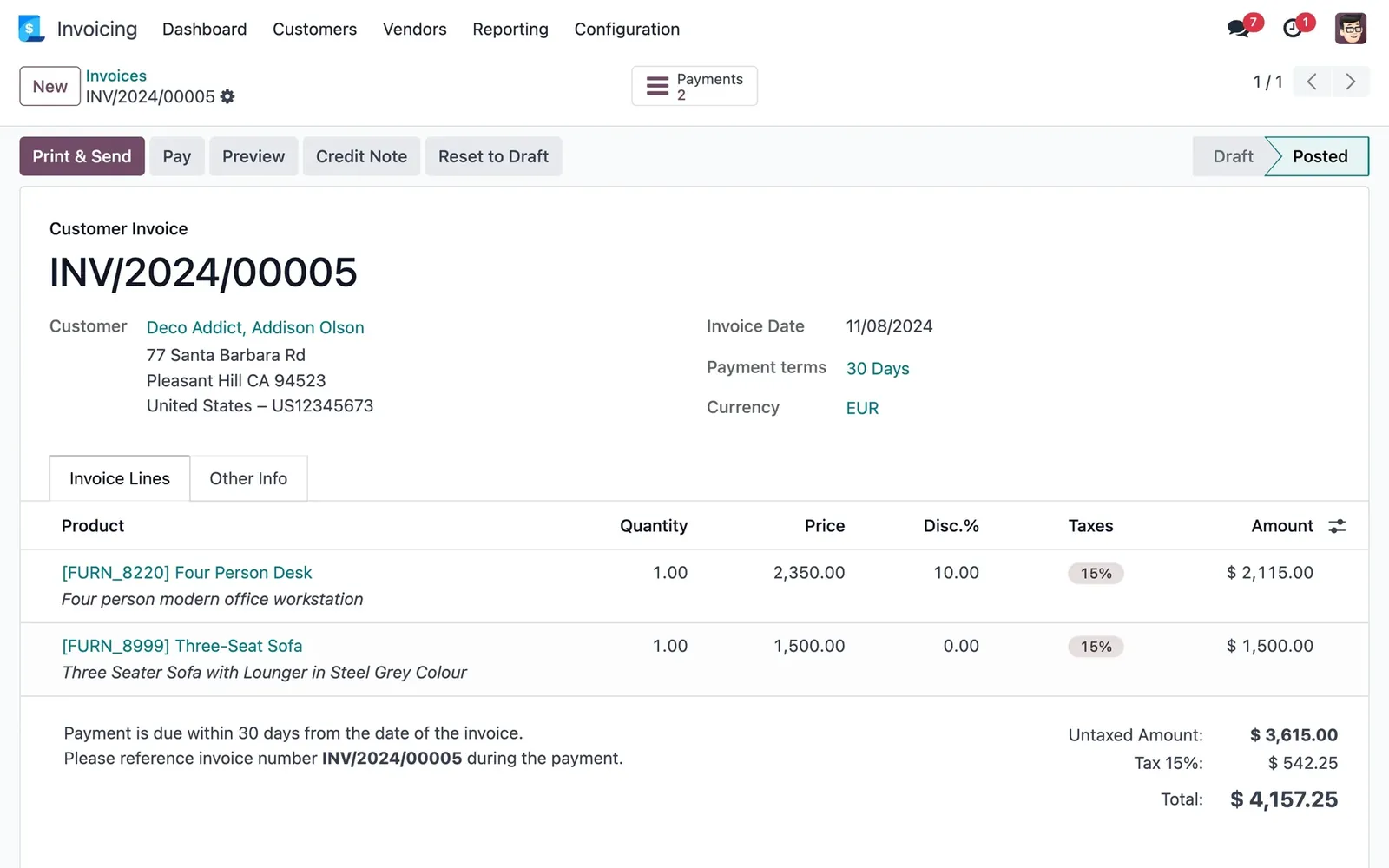
In a Singapore Odoo project, TechNext helps you work out your implementation date from your 2025 supplies (the IRAS notification is the final word) and sets up your invoices in Odoo. TechNext is not an InvoiceNow Access Point Provider: we work with the IMDA-accredited Access Point Provider you choose, and plan with them how invoice data leaves your Odoo database.
Rules change. This article reflects IRAS's GST InvoiceNow Requirement page as of September 2026; always check the latest IRAS guidance and e-Tax Guide before acting.
Yes. IRAS requires all GST-registered businesses to submit invoice data using InvoiceNow-Ready Solutions, rolled out in phases between 1 November 2025 and 1 April 2031.
It depends on total annual supplies in 2025: S$200,000 or less from 1 April 2028, S$1 million or less from 1 April 2029, S$4 million or less from 1 April 2030, and above S$4 million from 1 April 2031.
Overseas entities, including overseas vendors under the OVR pay-only and full regimes, and businesses liable to register for GST wholly because of the reverse charge regime.
Yes, on the Odoo side. TechNext helps you work out your implementation date and sets up your invoices in Odoo. We are not an Access Point Provider: we work with the IMDA-accredited Access Point Provider you choose, which carries your invoice data over the InvoiceNow network.
About TechNext. TechNext Pte. Ltd. is a BIR compliance and integration partner for accounting firms and finance teams: an Odoo Ready Partner headquartered in Singapore, with its main development and consulting hub in Taguig City, Metro Manila. We plug Odoo into the system you already run, and our own experts implement it end to end (discovery, configuration, data migration, training and support), set up with the Philippine (BIR) and Singapore (GST) localisations, for clients in 25+ countries. We are not affiliated with, accredited by or acting for the BIR or any government agency, and we do not file or register on your behalf. About us · Get my custom blueprint
Typing data twice, stock nobody trusts, a week-long month-end: seven signs it is time for one system.
Registering manual, loose-leaf and computerized books in ORUS: deadlines, the BIR's step-by-step guide, the QR stamp and common mistakes.
Pre-printed ATP invoices vs system-generated invoices: who needs an ATP, back-up booklets for a CAS or POS, no more five-year expiry, and the Odoo invoice layout.
TechNext sets up your Odoo, can build your website and brand on it, and stays on after go-live, in Singapore and the Philippines. An adviser reviews your situation first.
2027 BIR Audit Guide · sent by our team
Four details. A BIR Compliance Expert sends the guide to your work email within one business day. Inside: the eLA rules, the 10-day document rule, what examiners ask for, and a routine for audit requests.


