
BIR e-invoicing by 31 December 2026: plan your Odoo for it
The BIR requires covered taxpayers to issue e-invoices by 31 December 2026 (RR 26-2025, RMC 98-2026): invoices the BIR can receive, not PDFs from a printer. We advise first, check with your accountant whether you are covered, then set up Odoo's invoicing for BIR requirements and assess what an EIS connection needs, as separate work.
- Deadline: 31 Dec 2026
- Invoices set up for BIR and CAS requirements
- Odoo Ready Partner
At a glance
- Deadline
- 31 December 2026, under RR 26-2025 and RMC 98-2026
- First step
- A Permit to Issue (PTI) Electronic Invoice
- Then
- EIS Certification within six months of the PTI
- Applies to
- Head office and every branch
The Bureau of Internal Revenue (BIR) requires covered taxpayers to issue compliant electronic invoices on or before 31 December 2026. Covered now: e-commerce sellers classed as small, medium or large, Large Taxpayers Service accounts, large taxpayers, and businesses on a Computerized Accounting System (CAS) or Computerized Books of Accounts (CBA) with invoicing software. Micro taxpayers are exempt. You need a Permit to Issue first, then EIS Certification within six months. TechNext sets up Odoo for BIR requirements. Odoo has no built-in connection to the BIR's EIS, and TechNext has not built one. If you are covered, we assess the options with you and quote any connection separately.
Where BIR requirements hurt today.
What finance teams tell us before an Odoo project, and what changes once the BIR work lives in one system.
Odoo for the Philippines (BIR)- Invoices that can't be sent
A printed or emailed PDF is not an e-invoice. Covered taxpayers need a system that transmits sales data to the BIR; standard Odoo does not include that connection, so we assess the options with you.
- 2307s typed by hand
Chasing and re-typing withholding certificates every quarter. Odoo 20 generates BIR 2306 and 2307 certificates from vendor bills.
- Month-end in Excel
SLSP, SAWT and QAP rebuilt from spreadsheets. In Odoo they come from the same entries, with DAT exports for the BIR's tools.
- CAS paperwork
A system description and sample outputs for your application. With Odoo set up first, the outputs come from the system you will actually use.
- Branches doing it differently
The rule covers head office and every branch. One Odoo database gives every branch the same invoice flow.
- Digging for an audit
Posted entries keep their history and attachments, so the documents an examiner asks for are easier to find.
Who must issue e-invoices by 31 December 2026.
| Group | Status |
|---|---|
| Small, medium and large taxpayers selling through e-commerce or internet transactions | Covered by 31 Dec 2026 |
| Taxpayers under the Large Taxpayers Service (LTS) | Covered by 31 Dec 2026 |
| Large taxpayers under the Ease of Paying Taxes Act (RA 11976) and RR 8-2024 | Covered by 31 Dec 2026 |
| Businesses on CAS or CBA with e-invoicing or other invoicing software | Covered by 31 Dec 2026 |
| Micro taxpayers | Exempt |
The BIR Commissioner can require other taxpayers to comply. Not sure which group you are in? Check with your accountant or your Revenue District Office; we do this with you in discovery.
What the guidelines ask for.
RMC 98-2026, issued on 22 September 2026, sets out the working rules. These are the ones that shape your Odoo setup.
BIR rules for your accounting system- 1A Permit to Issue (PTI)
You need a PTI Electronic Invoice before you issue any e-invoice.
- 2EIS Certification
Completed within six months of getting the PTI.
- 3A system that transmits
Your system must send the required sales data to the BIR's Electronic Invoicing System.
- 4No edits after issue
An issued e-invoice cannot be deleted or changed. A credit note covers a decrease; a new e-invoice covers an increase.
- 5A plan for downtime
If the system is down, issue a BIR-authorised manual invoice, then replace it with an e-invoice that references it.
- 6Every branch
Head office and all branches issue e-invoices; different invoicing systems may need separate PTIs.
What Odoo 20 already does for the BIR.
The Philippine localisation produces the data for the recurring BIR reports. Odoo has no built-in connection to the BIR's EIS, and TechNext has not built one.
 In Odoo 20
- Invoices set up for BIR and CAS requirements, and a Book of Accounts for CAS and CBA
- BIR 2306 and 2307 certificates as PDFs, generated on vendor bills
- SLSP, SAWT and QAP with DAT exports, and the 2550Q VAT summary
- Payroll with the 1601-C, 2316 and 1604-C
- An assessment of the EIS connection options if you are covered; any connection work is quoted separately
- Invoice layouts and branch flows checked against the guidelines
- Credit-note and manual-invoice catch-up set up before go-live
- Sample outputs and process flow for the PTI you apply for
Sources: the Odoo 20 release notes and the Philippine localisation documentation. The issuances behind it: BIR rules for your accounting system.
Sample BIR reports from Odoo.
What your 2307, SLSP, QAP, SAWT and VAT summary look like when they come from the same entries as your books. Fictitious company and figures, for illustration.
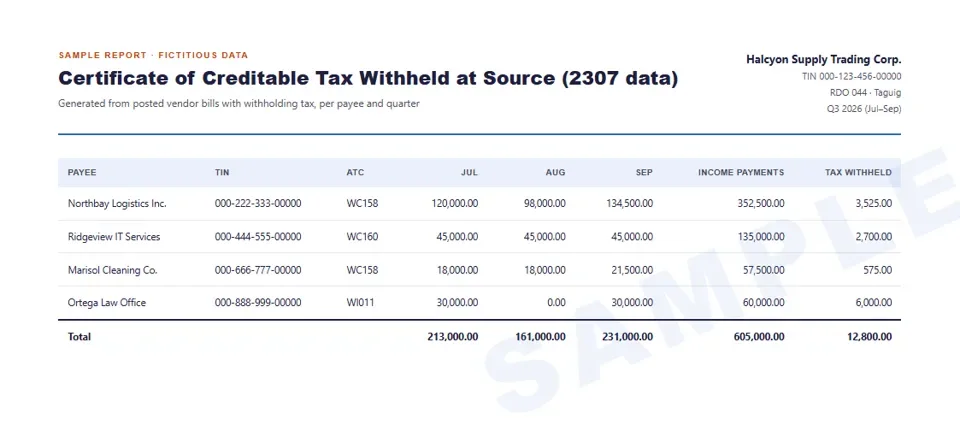 2307 certificate dataPer payee and quarter, from posted vendor billsSample data
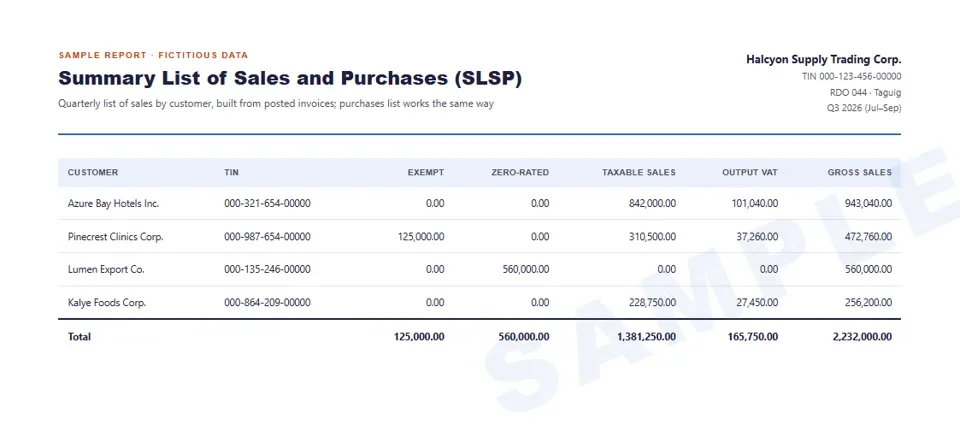 SLSP: sales and purchasesQuarterly summary list, exported as a DAT fileSample data
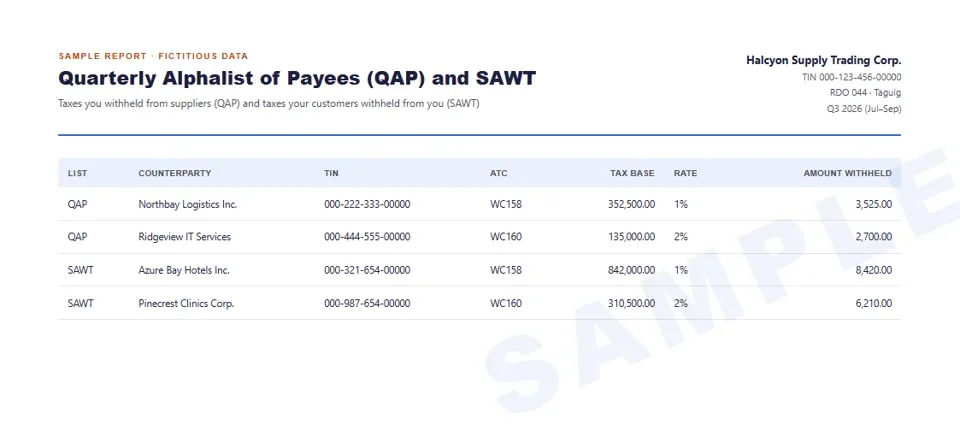 QAP and SAWTTaxes you withheld, and taxes withheld from youSample data
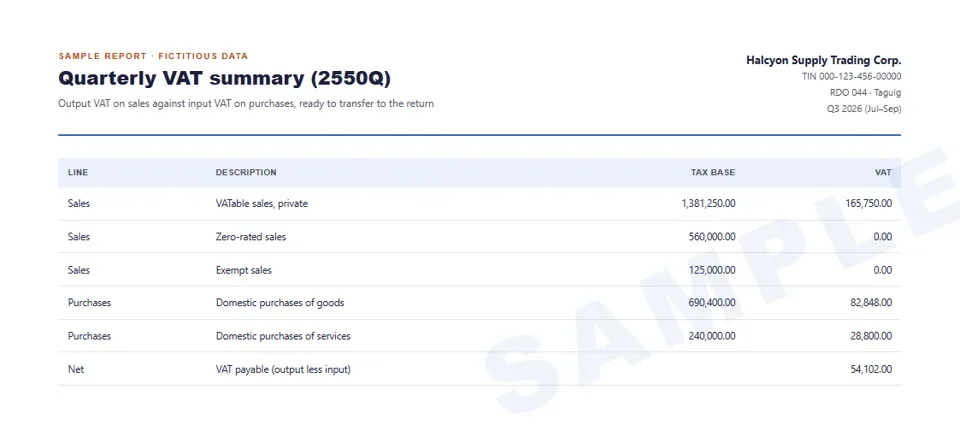 2550Q VAT summaryOutput against input VAT, for your returnSample data
From "are we covered?" to an e-invoicing plan for your Odoo.
You don't need to hire your own team. We advise, set up, test and stay on after go-live.
- 1Confirm your group
With your accountant: covered now, later, or exempt.
- 2Map your invoice flows
Customer invoices, credit notes, branches, anything issued outside your system today.
- 3Set up the localisation
Taxes, withholding, BIR reports and invoice layouts, tested on your real data.
- 4Assess the EIS connection
What sending invoice data from your Odoo version and hosting would need, quoted as separate work.
- 5Prepare your PTI papers (you apply)
Process flow and sample invoices from your Odoo, prepared with you.
- 6Go live and stay on
Downtime and correction flows set up and tested before go-live, then Odoo support from the team that set it up.
BIR e-invoicing, answered.
What is the BIR e-invoicing deadline?
Covered taxpayers must issue compliant electronic invoices on or before 31 December 2026. RR 26-2025 set the date and RMC 98-2026 kept it.
Are micro taxpayers covered by BIR e-invoicing?
No. Micro taxpayers are exempt from mandatory BIR e-invoicing, and e-commerce coverage applies to sellers classed as small, medium or large.
What is a Permit to Issue (PTI)?
A Permit to Issue (PTI) Electronic Invoice is the BIR permit a covered taxpayer needs before issuing any e-invoice. EIS Certification must then be completed within six months of the PTI.
Is Odoo BIR compliant?
No software is certified as BIR compliant: the BIR has not accredited or endorsed any software or e-invoicing provider (BIR advisory, 14 September 2026), and the permit is issued to your business for the system you register. Odoo 20's Philippine localisation covers invoices set up for BIR and CAS requirements, a Book of Accounts, 2306 and 2307 certificates, SLSP, SAWT, QAP and 2550Q. Its release notes do not cover an EIS connection, and TechNext has not built one; we assess what one needs and plan it as separate work. You file your CAS and e-invoicing applications with the BIR yourself. See BIR rules for your accounting system.
Can we fix an e-invoice after it is issued?
No. Issued e-invoices cannot be deleted or changed. Use a credit note for a decrease and a new e-invoice for an increase; we set both flows up in Odoo before go-live.
Does BIR e-invoicing cover our branches?
Yes. BIR e-invoicing covers head office and all branches, and branches on different invoicing systems may need separate PTIs. See BIR rules for multi-branch businesses.
Sources
Updated 21 October 2026
- Revenue Regulations (RR) No. 11-2025
- Revenue Regulations (RR) No. 26-2025
- Revenue Memorandum Circular (RMC) No. 98-2026
- Revenue Memorandum Circular (RMC) No. 110-2026
- BIR public advisory on the EIS, 14 September 2026
As of October 2026, as summarised by Grant Thornton and KPMG. General guidance, not tax advice. Rules change: confirm with your accountant or the BIR before acting. TechNext is an Odoo Ready Partner. We are not affiliated with, accredited by or acting for the BIR or any government agency, and we do not file or register on your behalf.
Planning your e-invoicing for the BIR?
Tell us how you invoice today and which BIR forms you file. An adviser will say what Odoo covers and what it would take before 31 December 2026.