

BIR compliance5 min read
BIR e-invoicing requirements: who is covered, the deadline and how to prepare in Odoo
Who must issue BIR electronic invoices by 31 December 2026, what a Permit to Issue is, and how to prepare Odoo.
DeadlinesE-Invoicing by Dec 31, 20262026 Computerized Books in ORUS by Jan 30, 2027E-Invoicing Dec 31 · ORUS Jan 30
Check ReadinessSince the Ease of Paying Taxes Act, the invoice is the proof of sale for goods and services alike, and the official receipt is only a supporting document. Here is everything RR 7-2024, as amended, asks your invoice to show, what happens when a field is missing, and how to set up the layout in Odoo.
Prepared by the TechNext Philippines Odoo and finance team, Taguig City.
By TechNext · · Updated · 7 min readBIR compliance
Key takeaways
The EOPT Act changed the most-printed document in your business. Service companies that used to issue official receipts on payment now issue invoices on billing. Every seller has to check that its invoice shows the right fields in the right words. Get it wrong and your buyer may lose the input VAT, which is a quick way to lose a customer's goodwill. This guide lists the rules and how to set up Odoo.
| Seller | When an invoice is required |
|---|---|
| VAT-registered | Every sale, regardless of amount (Tax Code Section 237) |
| Non-VAT | Sales of P500 or more, or whenever the buyer asks. Smaller sales are totalled into one invoice at the end of the day once they reach P500. The amount is adjusted for inflation every three years. |
RR 7-2024 Section 6(B) lists the information, and RR 6-2026, dated 25 August 2026 and in force since 16 October 2026, added item 22: the creditable withholding tax, shown as a separate item. The core fields:
| Field | What to print |
|---|---|
| Seller name | Registered name as on your Certificate of Registration (a trade name may be added) |
| Registration and TIN | "VAT Reg TIN" or "Non-VAT Reg TIN", followed by the TIN and branch code |
| Address | The registered business address where the invoice is used |
| Title | The word "Invoice", printed prominently or larger than any descriptor such as "Billing" |
| Date and serial number | Transaction date, and a serial number printed prominently |
| Buyer | A space for the buyer's name, address and TIN. Required for sales of P1,000 or more to a VAT-registered buyer; not needed for end consumers. |
| Lines | Quantity, unit cost and description of the goods or nature of the service |
| Totals | Total amount (VAT-inclusive if VAT-registered) with VAT shown as a separate item |
| Withholding tax | Where creditable withholding tax applies, the amount withheld shown as a separate item. Newly printed invoices must carry the phrase "Less: Withholding Tax" (RR 6-2026) |
| Mixed sales | A breakdown into VATable sales, VAT, zero-rated sales and VAT-exempt sales, or separate invoices labelled "VAT-Exempt Sale" or "Zero-Rated Sale" |
| Special discounts | For senior citizen, PWD and similar discounts: the ID number, the discount and VAT exemption breakdown, and a signature space |
| System footer | For CAS or CBA invoices: the PTU number or Acknowledgement Certificate control number (ACCN), the series range and the date issued at the bottom, and "REPRINT" shown prominently at the top of reprints |
Supplementary documents such as delivery receipts, official receipts and credit memos must carry, in bold: THIS DOCUMENT IS NOT VALID FOR CLAIM OF INPUT TAX.
Under RR 7-2024 and Section 113(D) of the Tax Code, a missing field makes the seller liable, but the buyer keeps its input VAT, unless the missing item is one of these five:
Two more traps: a non-VAT seller that issues a VAT invoice owes the VAT anyway, and a VAT-exempt sale invoiced without the "VAT-Exempt" label can be taxed as if the exemption did not apply.
RR 11-2024 gave two options for unused ORs. You can use them as supplementary documents, stamped "not valid for claim of input tax", or convert them into invoices by striking out "Official Receipt" and stamping "Invoice". Converted receipts can be used until they run out. System-generated "official receipts" issued after 31 December 2024 are not evidence of a sale. Under RR 6-2026, unused invoice stock without the new withholding line can still be used until it runs out. RMC 112-2026 (22 October 2026) clarifies that "Less: Withholding Tax" and the amount are stamped only on sales subject to withholding, that invoices printed under a new ATP must carry the line, and that systems have until 31 December 2026 (CAS and CBA covered by e-invoicing) or 31 March 2027 (POS, CRM and other invoicing systems) to add the field, with printed invoices stamped in the meantime.
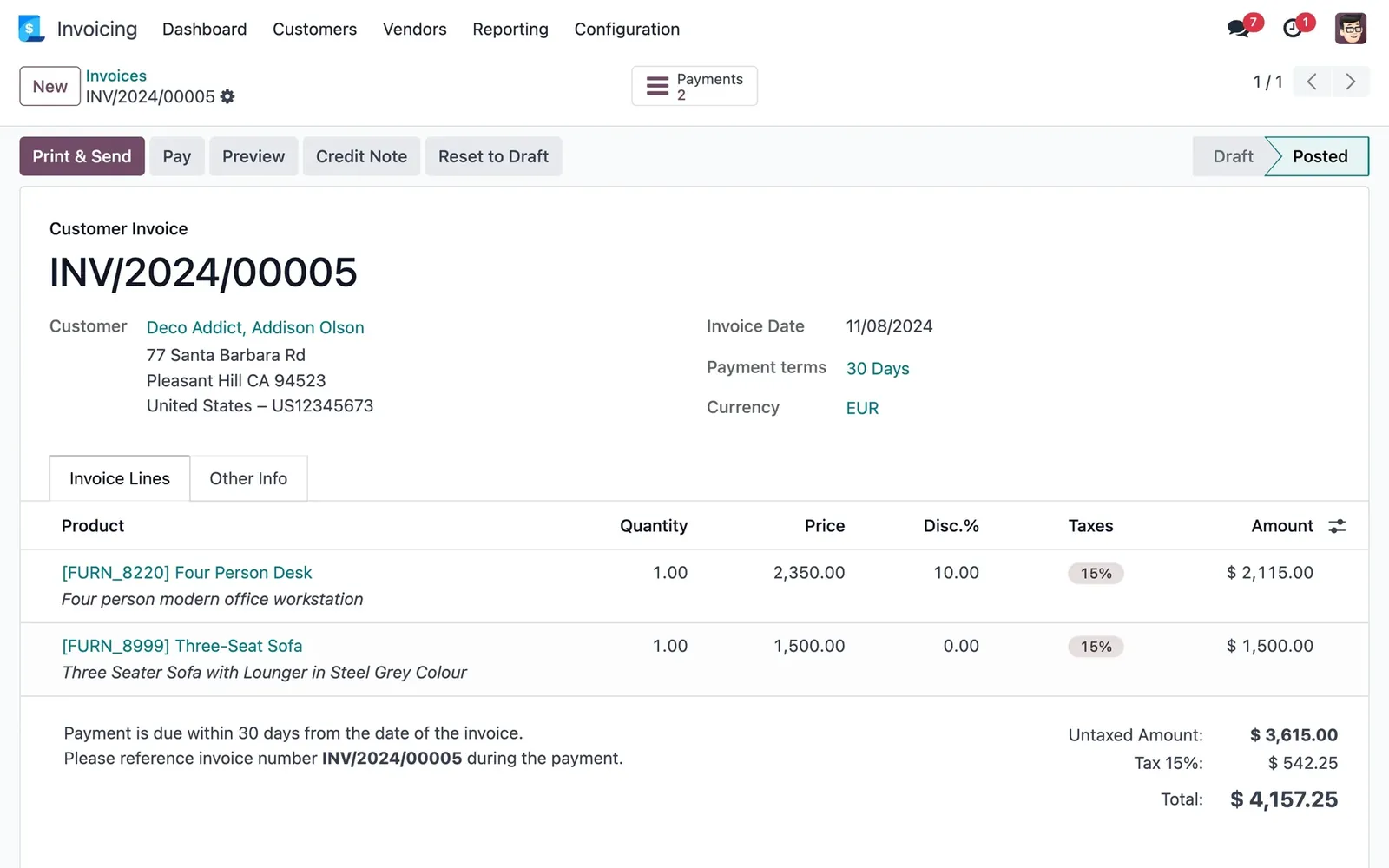
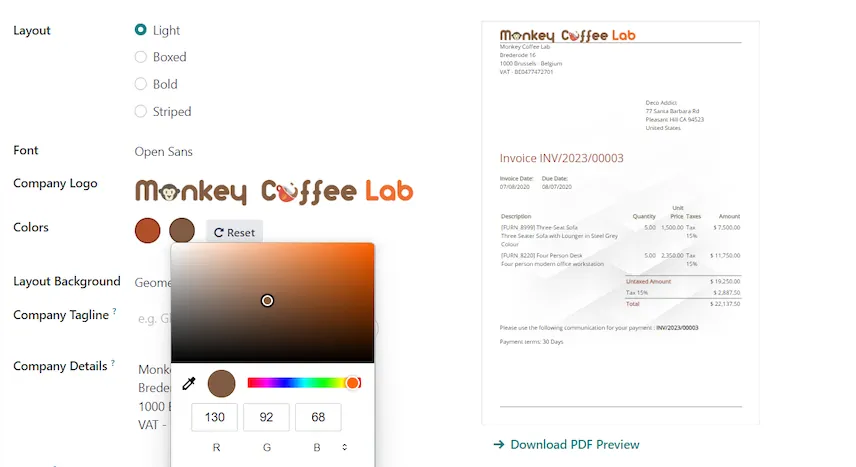
Odoo's Philippine localisation already holds most of the data: your TIN with branch code and RDO on the company, the customer's TIN on the contact, and default taxes for 12% VAT, zero-rated and exempt sales. What decides compliance is the printed layout.
You don't need to hire your own team. A TechNext adviser reviews your invoices against the rules first, then our team in Taguig City sets up the Odoo layout and series, and we check sample invoices with you against the rules before go-live. See how we set up Odoo for BIR requirements.
Rules change. This article reflects RA 11976 (EOPT Act), RR 7-2024, RR 11-2024, RR 6-2026, RMC 77-2024, RMC 98-2026 and RMC 112-2026, read from the law and the BIR's documents or official copies, and the Odoo 19.0 documentation and Odoo 20 release notes, as available on 21 October 2026 (RMC 112-2026 added on 8 November 2026). It is not tax advice: confirm with your accountant or RDO before you act.
The invoice is now the proof of sale for services too. An official receipt may still be issued when payment is collected, but only as a supplementary document.
For sales of P1,000 or more to a VAT-registered buyer, the invoice must show the buyer's registered name, address and TIN (Tax Code Section 113(B)).
The PTU number or Acknowledgement Certificate control number, the series range and the date issued, under RR 7-2024 Section 6(B.21).
Yes, under RR 11-2024: either as supplementary documents stamped "not valid for claim of input tax", or converted into invoices by stamping "Invoice", until they run out.

About TechNext. TechNext Pte. Ltd. is a BIR compliance and integration partner for accounting firms and finance teams: an Odoo Ready Partner headquartered in Singapore, with its main development and consulting hub in Taguig City, Metro Manila. We plug Odoo into the system you already run, and our own experts implement it end to end (discovery, configuration, data migration, training and support), set up with the Philippine (BIR) and Singapore (GST) localisations, for clients in 25+ countries. We are not affiliated with, accredited by or acting for the BIR or any government agency, and we do not file or register on your behalf. About us · Get my custom blueprint
Who must issue BIR electronic invoices by 31 December 2026, what a Permit to Issue is, and how to prepare Odoo.
Pre-printed ATP invoices vs system-generated invoices: who needs an ATP, back-up booklets for a CAS or POS, no more five-year expiry, and the Odoo invoice layout.
Accreditation of the POS software vs the Permit to Use for each machine, the eAccReg steps, receipt fields, Z-readings, PTU cancellation and where Odoo Point of Sale fits.
TechNext sets up your Odoo, can build your website and brand on it, and stays on after go-live, in Singapore and the Philippines. An adviser reviews your situation first.
2027 BIR Audit Guide · sent by our team
Four details. A BIR Compliance Expert sends the guide to your work email within one business day. Inside: the eLA rules, the 10-day document rule, what examiners ask for, and a routine for audit requests.


