
BIR compliance6 min read
Expanded withholding tax and BIR ATC codes: the rules, and how to set them up in Odoo
EWT deadlines, the common ATC codes and rates, the 2025 top withholding agent changes, and how withholding taxes work in Odoo.
BIR noticeE-invoicing is due by 31 December 2026 for covered taxpayers, including businesses on a CAS or CBA with invoicing software.E-invoicing is due by 31 Dec 2026 for covered taxpayers.
CAS set-up in OdooOdoo 20's release notes add a basic Philippine payroll package for the BIR's 1601-C, 2316 and 1604-C. Here is what it does for each form, the rules your payroll has to follow in 2026, and the parts that are still project work.
Prepared by the TechNext Philippines Odoo and finance team, Taguig City.
By TechNext · · Updated · 5 min readBIR compliance
Key takeaways
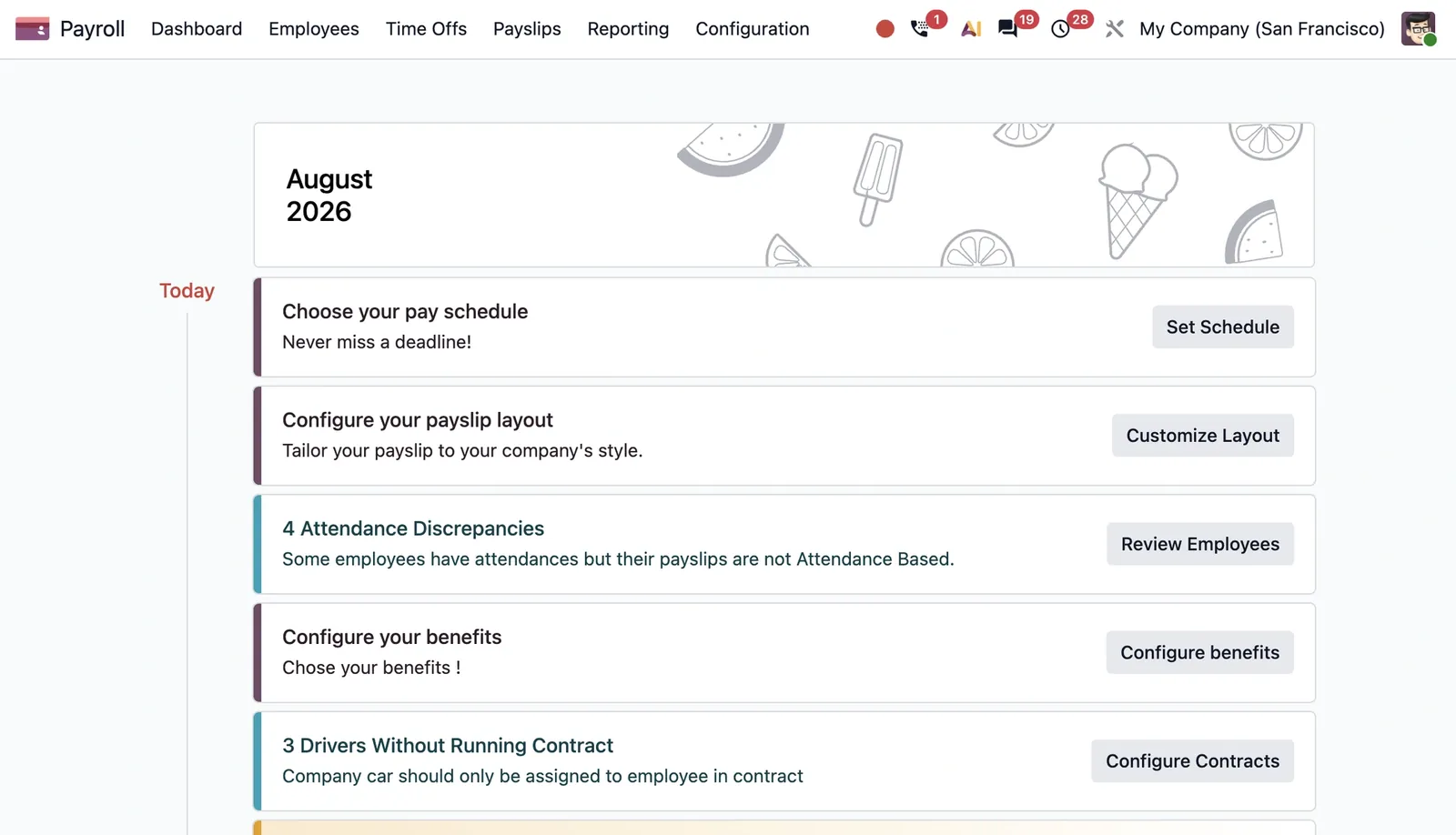
Payroll is where BIR rules meet every employee. A wrong bracket or a missed benefit cap shows up twice: in the 1601-C you remit every month, and again in each employee's 2316 at year-end. Odoo 20's release notes add a Philippine payroll package from Odoo itself; before that, companies typically relied on community or third-party apps. This guide sets out what it covers, according to Odoo, and what the rules ask for.
The Odoo 20 release notes list:
Two things to note. The Philippines is not yet on the Odoo 20.0 payroll localisations documentation page, so the release notes are the reference for now. And the release notes do not name the SSS, PhilHealth or Pag-IBIG contribution tables, the 13th month or de minimis benefits, so plan to check those in your setup.
| Form | What it is | When |
|---|---|---|
| 1601-C | Monthly remittance of tax withheld on compensation | 10th of the following month for eBIRForms (non-eFPS) filers (15 January for December). eFPS filers follow staggered filing dates by group, from the 11th to the 15th; for December, published calendars put the eFPS e-payment for every group on 20 January. |
| 2316 | Certificate of compensation and tax withheld, given to each employee | By 31 January of the following year, or on the last pay if employment ends earlier (Tax Code Section 83) |
| 1604-C with alphalist | Annual information return of compensation and tax withheld | By 31 January of the following year |
| Signed 2316 copies | Substituted filing for employees with one employer and correct withholding | Submitted to the BIR by 28 February |
Before the December return, the employer does a year-end adjustment: annualise each employee's compensation and settle any tax still due or refund any excess. That is the step Odoo 20's annualisation report supports.
From 1 January 2023, the TRAIN Law's graduated table applies (Tax Code Section 24(A)):
| Annual taxable income | Tax |
|---|---|
| Up to P250,000 | 0% |
| Over P250,000 to P400,000 | 15% of the excess over P250,000 |
| Over P400,000 to P800,000 | P22,500 + 20% of the excess over P400,000 |
| Over P800,000 to P2,000,000 | P102,500 + 25% of the excess over P800,000 |
| Over P2,000,000 to P8,000,000 | P402,500 + 30% of the excess over P2,000,000 |
| Over P8,000,000 | P2,202,500 + 35% of the excess over P8,000,000 |
Agencies update these tables by circular. Confirm the current rates with each agency before a pay run, and update the rules in Odoo when they change.
From our experience setting up payroll, these parts depend on your company and should be in the plan:
You don't need to hire your own team. A TechNext adviser maps your pay rules first, then our team in Taguig City sets up Odoo Payroll and runs parallel pay runs with you before go-live. See Odoo in the Philippines.
Rules change. This article reflects the Tax Code as amended by TRAIN, BIR regulations, agency circulars and the Odoo 20 release notes as available on 21 October 2026. De minimis amounts under RR 29-2025 are taken from published tax alerts. It is not tax or payroll advice: confirm with your accountant, the BIR, SSS, PhilHealth and Pag-IBIG before you act.
Yes. The Odoo 20 release notes list a basic Philippine payroll package with 1601-C items, the 2316, 1604-C worksheets, alphalist DAT exports and SSS and Pag-IBIG loan deductions.
By 31 January of the following year, or on the day of the last wage payment if they leave earlier (Tax Code Section 83).
Only the part above P90,000 a year, counted together with other bonuses and benefits under Section 32(B)(7)(e) of the Tax Code.
Odoo's own Philippine payroll package is listed in the Odoo 20 release notes. Earlier versions typically relied on community or third-party apps. If you are on an older version, plan an upgrade; see our Odoo 20 upgrade checklist.
About TechNext. TechNext Pte. Ltd. is a trusted expert adviser for ERP and compliance: an Odoo Ready Partner headquartered in Singapore, with its main development and consulting hub in Taguig City, Metro Manila and an AI engineering hub in Ho Chi Minh City. Our own experts implement Odoo end to end (discovery, configuration, data migration, training and support), set up with the Philippine (BIR) and Singapore (GST) localisations, for clients in 25+ countries. We are not affiliated with, accredited by or acting for the BIR or any government agency, and we do not file or register on your behalf. About us · Get a quotation
EWT deadlines, the common ATC codes and rates, the 2025 top withholding agent changes, and how withholding taxes work in Odoo.
SAWT vs QAP, the deadlines under RMC 55-2026, why files get rejected, and how Odoo exports both as DAT files.
How BIR audits work in 2026, what examiners ask for within ten days, and the Odoo features that help keep your records organised.
TechNext sets up your Odoo, can build your website and brand on it, and stays on after go-live, in Singapore and the Philippines. An adviser reviews your situation first.